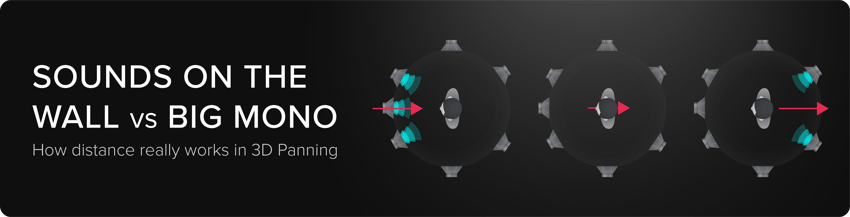


Imagine you want to create a sound that passes through the listener — starting in front, moving across, and ending behind them.
Simple idea, right? In reality, this is where many 3D panners start to fall apart.
Let’s break down why.
The Myth of “Radius = Distance”
In theory, a radius (or distance) control should define how far a sound is from the listener.
But in most current 3D panners, that’s not really what’s happening. Instead:
- Maximum radius → sound is placed on the “walls” (i.e., speakers around you)
- Minimum radius → sound collapses to the listener
And here’s the catch: when a sound reaches the minimum distance, it often becomes what we can call a “big mono” — meaning all speakers are reproducing the same signal.

The Problem: Where Is the Sense of Distance?
If all speakers are playing the same thing:
- There’s no spatial contrast
- No sense of depth or proximity
- And often, you introduce comb filtering, because multiple speakers are reproducing the same signal with slight timing differences
The result? You lose intimacy. You lose precision. You lose realism.
Distance Is Also About Size
Distance isn’t just about how far something is — it’s also about how big it feels.
Take a helicopter as an example:
- Far away → it behaves like a point source (small, focused, maybe even coming mostly from one direction)
- Getting closer → it becomes larger, more immersive
- Very close → it surrounds you — you’re inside the sound
Now imagine the opposite: a helicopter right next to you… coming from a single speaker. That doesn’t feel real at all.
A close sound should feel wide, enveloping, physical.
A distant sound should feel focused and small.
Most panners don’t truly connect radius with this perception of size.
The “Passing Through” Problem
Let’s go back to our original example:
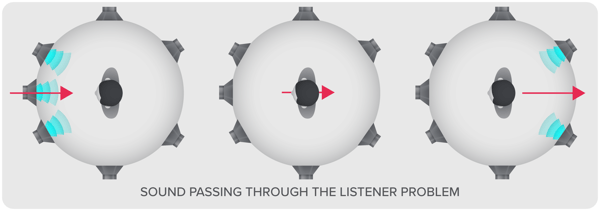
A sound moving from front → through the listener → back
With many systems, this happens:
- The sound is in front (center/front speakers)
- It reaches the listener… and collapses
- Then it suddenly appears in the back
This creates discontinuities, clicks or artifacts, and a very unnatural transition.
Why? Because the system is jumping between speaker configurations instead of treating the sound as a continuous object.
Two Common Workarounds
To avoid these issues, people often rely on two approaches:
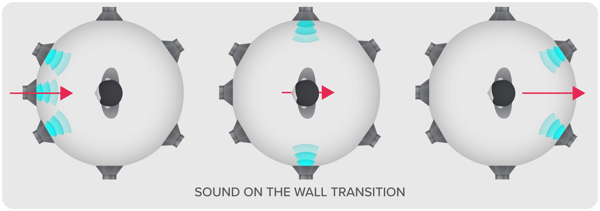
1. “Sound on the Wall”
Force the sound to stay on the speaker array:
- Avoids the sound collapsing to the center
- Keeps motion stable
- But limits true proximity and immersion
2. “Big Mono” Transitions
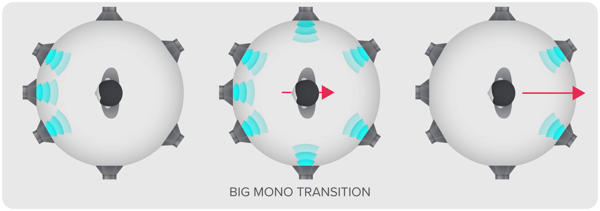
Use a moment where:
- The sound becomes fully spread (all speakers)
- Then redistributes to the back
This smooths transitions, but:
- Still lacks true spatial meaning
- Can introduce phase issues
- Dilutes the spatial resolution of the sound
How Does Sound Particles Handle Radius?
In Sound Particles’ plugins, the approach has traditionally leaned toward sounds on the wall, ensuring stability and predictability in spatialization.
With Sound Particles 3, we introduce a different behavior.
Since sounds behave like objects in space, not just signals routed to speakers, distance plays a more meaningful role.
When particles enter a defined minimum distance to the “mic”, they transition into a big mono behavior. But importantly:
- This transition is distance-based, not time-based
- It happens naturally as part of the motion
- And this prevents abrupt jumps or artifacts
Conclusion
3D panning isn’t just about placing sounds around a listener — it is also about how those sounds behave as they move through space.
When distance is treated as a simple control between “center” and “walls,” you lose the nuances that make audio feel real: proximity, scale, and continuity.
The challenge is not just getting a sound from front to back, but making that journey feel smooth, physical, and believable.
By rethinking distance as something dynamic — something that influences not just position, but also size and behavior — your production becomes more in alignment with how we actually experience sound in the real world.
And that’s where true immersion begins.
Have any questions? Leave a comment or get in touch — we’d love to hear from you!
Share your experiences with us using #MadeWithSoundParticles and don’t forget to tag us!
Topics: Sound Particles, Audio Software, Sound Design, Tutorials, Cinema, Audio tech, 3D audio, Surround Sound, Music